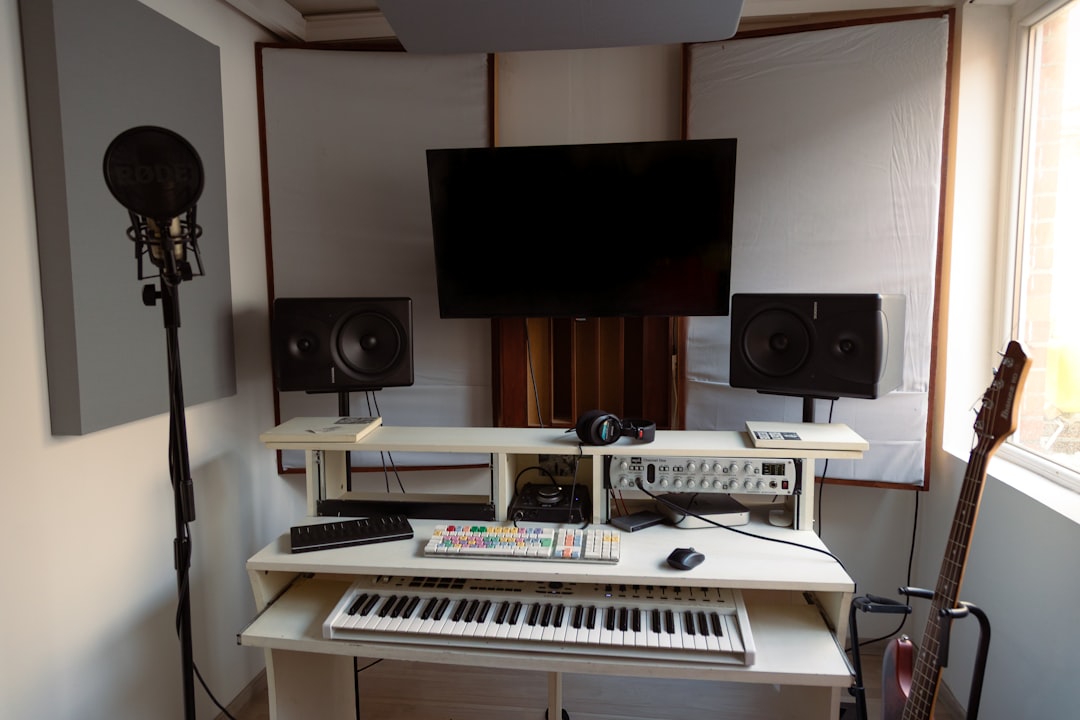
A Spanish voice over home studio doesn't need to cost $50,000. It doesn't need to look like Abbey Road. What it needs is to sound clean, connect reliably, and let you deliver professional work without excuses. I started with a $100 microphone in a closet lined with moving blankets. Work buys gear — gear doesn't buy work. That principle hasn't changed in 20+ years.
But there's a difference between "you don't need the best gear" and "gear doesn't matter." It matters. Just not in the way most people think.
The Room Is the Studio
Here's what nobody tells you when you're starting out: the microphone is maybe 20% of your sound. The room is 80%.
A $3,000 Neumann in an untreated bedroom sounds worse than a $300 Rode in a properly treated booth. Sound waves bounce off hard surfaces — walls, ceilings, windows, that IKEA bookshelf you thought would help. Those reflections reach the microphone milliseconds after your voice does, creating a subtle but unmistakable muddiness. Clients can't always articulate it, but they hear it. And they reject it.
According to a 2022 survey by the Audio Engineering Society, room acoustics account for more perceived audio quality variation than any single piece of equipment. The professionals they surveyed rated acoustic treatment as the number one factor in home recording quality voice over — above microphones, preamps, or interfaces.
Treat your corners first. Bass builds up there. Then your first reflection points — the spots on the walls where sound bounces directly from your mouth to the microphone. You can find them with a mirror: sit at your recording position, have someone slide a mirror along the wall, and wherever you can see your mouth is a reflection point. Cover those.
What Microphone Actually Works
The microphone wars are exhausting.
Every forum has someone insisting you need a $4,000 condenser or you're not a real professional. Every YouTube channel has someone claiming their $80 USB mic is "broadcast quality." Both are wrong. The truth is boring: a solid large-diaphragm condenser between $300 and $800 will serve you for years. I've recorded campaigns for Ford, Netflix, and Google with microphones in that range. Nobody called to complain about my Neumann substitute.
What matters more than brand is consistency. Pick something, learn its quirks, and stick with it. Clients who work with you regularly get used to your sound. If you're swapping microphones every project, your voice sounds different every time — and that inconsistency raises questions about your professional voice studio Spanish setup that you don't want raised.
The Signal Chain Nobody Talks About
Your interface matters more than your microphone once you're past the $300 threshold.
A cheap interface adds noise. Not the obvious hiss you'd notice immediately, but a subtle grain that accumulates in post-production. When an editor compresses your audio (and they will), that grain gets louder. When they EQ it, the grain shifts in frequency but doesn't disappear. A Focusrite Scarlett, an Audient iD, a Universal Audio Volt — any of these will give you clean gain without mortgage-level investment.
And your cables? Have you ever actually checked your cables? I once spent three hours troubleshooting a mysterious crackle that turned out to be a frayed XLR I'd been using for eight years. Cables are the component everyone ignores until they fail during a session. Buy decent ones, label them, replace them when they start acting suspicious.
Source Connect Changed Everything
The pandemic accelerated something that was already happening: remote sessions became the norm, not the exception.
Source Connect is the industry standard for real-time remote recording. A 2023 report from the Voice Over Network found that 78% of professional voice over sessions now involve some form of remote connection, with Source Connect or similar protocols used in over 60% of those cases. When a client in Los Angeles wants to direct a session with a Spanish voice over artist in Buenos Aires (or anywhere else), Source Connect makes it possible without latency ruining the timing.
I have Source Connect Standard in my studio. It means a creative director can sit in their office, hear my takes in real time, and give adjustments exactly as they would if I were in the booth across from them. For brands working on tight deadlines — and they're all tight deadlines — this matters more than whether my microphone costs $400 or $4,000.
(The irony is that many clients who insist on Source Connect have never actually used it. They just know they're supposed to ask for it. Which is fine — it means the industry has standardized on something that works.)
Acoustic Panels Aren't Decoration
I've seen studios where the owner clearly bought acoustic panels because they look professional. They're mounted in a grid pattern on one wall like artwork, evenly spaced, aesthetically pleasing, and acoustically useless.
Acoustic treatment isn't about covering surfaces symmetrically. It's about breaking up specific problematic frequencies in specific locations. Bass traps go in corners because that's where low frequencies accumulate. Absorption panels go at reflection points because that's where mid and high frequencies bounce. Diffusers go on back walls to scatter sound rather than absorb it completely, which keeps your room from sounding dead.
But if I had to choose between a studio with $5,000 in premium panels mounted incorrectly and a closet stuffed with moving blankets positioned thoughtfully? The closet wins every time.
The Software Trap
Pro Tools, Logic, Audacity, Reaper — the software doesn't matter nearly as much as software companies want you to believe.
For voice over, you need to record, edit, and export. That's it. You're not mixing a 48-track album. You're not mastering for vinyl. You're recording your voice, cutting the mistakes, maybe adding a noise gate and light compression, and delivering a clean file. Audacity does this for free. Reaper costs $60.
Where software does matter is in your ability to punch in and out seamlessly, label takes quickly, and export in whatever format the client needs (usually WAV at 48kHz/24-bit, sometimes 44.1kHz/16-bit, occasionally mp3 for review). Learn whatever DAW you choose well enough that you're not fumbling during a live session. That's the skill. The software is just the tool.
Backup Everything Twice
Hard drives fail. It's not a question of if but when.
I lost an entire session once — 45 minutes of perfectly directed takes — because my primary drive died and I'd gotten lazy about backups. The client was understanding. The re-record went fine. But I will never, as long as I'm doing this work, forget the feeling of realizing those files were gone.
Now I record to my primary drive, back up to a local external drive immediately after each session, and sync to cloud storage overnight. Three copies minimum. The session isn't finished until it exists in three places. This isn't paranoia; it's professionalism.
What Actually Separates Amateurs From Professionals
Here's the thing: a client has never hired me because of my microphone. They've hired me because I can deliver exactly what they need, when they need it, without making them think about the technical side at all.
A professional voice studio Spanish setup means the client never hears room noise, never waits for technical problems to be solved, never receives a file that needs fixing. It means Source Connect works when they call, files arrive in the correct format, and the audio sounds exactly as good as my demo promised it would — because my demo was recorded in the same room with the same gear.
The amateur home studio reveals itself not through cheap equipment but through inconsistency. One day the audio sounds great; the next day there's a hum. One session connects perfectly; the next one drops repeatedly. That unpredictability costs clients time, and time is what they're actually paying to save.
The Gear I'd Buy If I Started Over Tomorrow
If I lost everything and had to rebuild from zero with $2,000, here's what I'd buy: a Rode NT1 ($270), an Audient iD4 ($200), a Source Connect Standard subscription ($400/year), Reaper ($60), basic acoustic panels and bass traps ($400), cables and a stand ($100), and a used Mac Mini ($500). That leaves room for a proper desk and chair.
Would it sound as good as my current studio? No. Would it sound good enough to book national campaigns while I reinvested earnings into upgrades? Absolutely.
When Upgrades Actually Make Sense
Upgrade when you're turning down work because of your setup. Upgrade when a client mentions an issue you know is technical. Upgrade when your equipment fails during a session and you realize you have no backup.
Don't upgrade because a forum convinced you that you're not legitimate without a certain preamp. Don't upgrade because your neighbor's brother-in-law who "works in audio" said your interface is garbage. The work pays for the gear, and the gear enables more work. Reverse that order at your own financial peril.
Need a Spanish voice over for your next project? Get in touch and I'll get back to you within the hour.