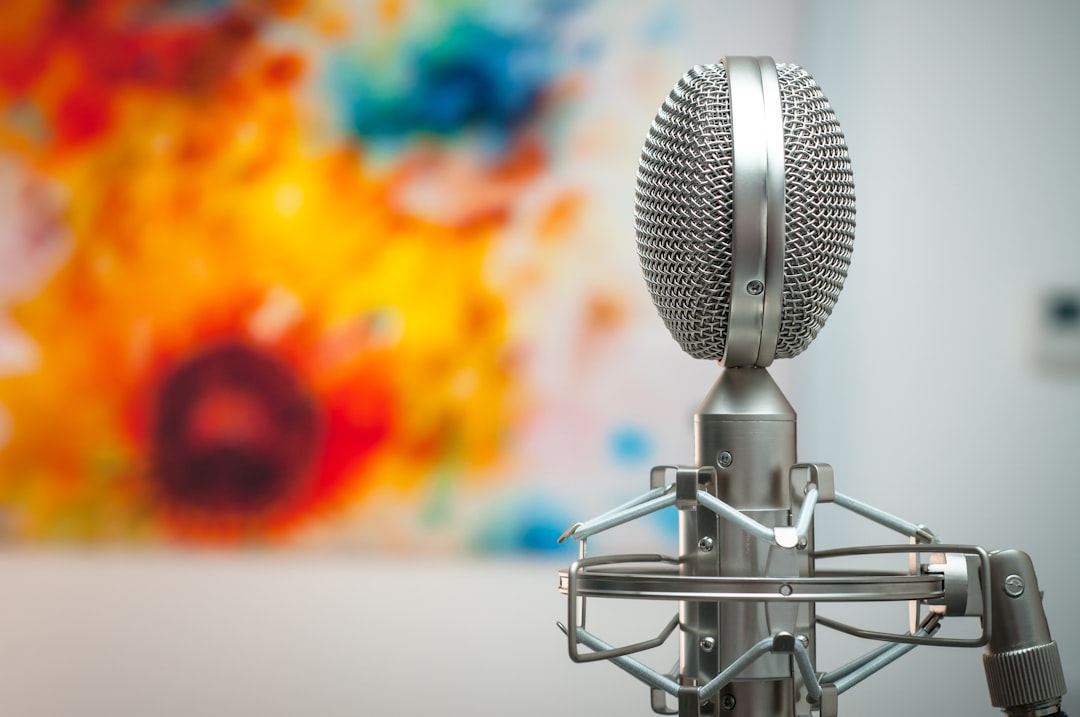
When you need a voice over artist vs when you don't comes down to one question: does this content need to persuade, teach, or build trust? If yes, hire a professional. If the content is purely functional — a notification sound, an internal memo nobody will actually read aloud, a test file — skip it. I've been in this industry for over twenty years, and the most expensive mistakes I've seen come from brands that got this decision backwards: spending money where it didn't matter, then cutting corners where it did.
The content that always needs a professional voice
Advertising. Brand videos. E-learning where someone actually needs to retain information. Customer-facing content of any kind. Anything that will represent your company to people who don't already work for you.
A 2023 Edison Research study found that 74% of Americans who listen to audio content say the voice quality directly affects whether they trust the information. That number climbs higher for Spanish-speaking audiences, where according to Nielsen's Diverse Intelligence Series, cultural authenticity signals carry significantly more weight in purchase decisions.
And here's the thing most people miss: the content you think is "internal only" often ends up somewhere else. I've had clients record e-learning modules for "just our warehouse team" that later became part of their onboarding for new hires across six states. The CFO's brother saw a safety training video at a trade show. What starts as internal has a way of becoming external when you're not paying attention.
When voice over genuinely doesn't matter
Phone system prompts that say "press one for sales." Placeholder audio for a prototype that will be replaced before launch. Test files for your development team. Audio that will play once, to three people, who are all in the same meeting.
If the stakes of failure are essentially zero — nobody will judge your brand, nobody will learn less, nobody will trust you less — then the voice over is a utility, and utilities can be handled cheaply or internally. I once had a client ask me to record temporary placeholder audio for an app demo they were showing to exactly one investor. I told them to have someone in the office do it. (They didn't listen, but that's another story entirely.)
The Spanish-specific calculation
Here's where brands consistently miscalculate. According to the US Census Bureau, there are now over 62 million Hispanic people in the United States. Pew Research reports that 72% of US Hispanics speak Spanish at home. This is not a niche market — it's the fastest-growing consumer segment in the country.
When your content targets Spanish speakers, the bar for professionalism goes up, not down. A non-native accent, an awkward translation, a synthetic voice — these register immediately to a native ear. Have you ever watched a dubbed movie where something felt off about the voice, even though you couldn't identify exactly what was wrong? That's what happens when brands try to save money on Spanish voice over. The audience knows. They always know.
For Spanish content specifically, professional voice over becomes necessary in more situations than English content would require. A quick internal video in English might be fine with someone from the marketing team reading it. The same video in Spanish, if it's going to anyone outside your building, needs a native professional in neutral Spanish — or you've just told your Spanish-speaking audience that they matter less.
The e-learning calculation
E-learning is the clearest case study for this decision. If the training is compliance content that employees click through to check a box while answering emails, and everyone knows that's what it is, then the voice quality barely registers.
But if the training covers industrial safety, operational procedures, financial compliance — anything where a mistake has real-world consequences — then voice quality directly affects retention. A 2022 study published in the Journal of Applied Psychology found that learners retained 23% more information when audio was delivered in a natural human voice compared to synthetic alternatives. Bad voice over in safety training costs real money in accidents.
The AI question
AI voices have gotten remarkably good at sounding human for about three seconds. Then something happens. The rhythm gets slightly mechanical. The emphasis lands in a place no native speaker would put it. The listener's brain starts working harder without knowing why.
A Stanford study on synthetic voice perception found that listeners experience measurably higher cognitive load when processing AI-generated speech, even when they can't consciously identify the voice as artificial. Your audience's body rejects synthetic voices before their conscious mind catches up.
For functional content — GPS directions, notification sounds, automated customer service routing — AI works fine. For anything persuasive or educational, the vibrational dimension of human voice matters. This isn't mysticism. The human voice produces micro-variations in pitch, timing, and breath that AI cannot replicate, and listeners respond to those variations even when they don't know they're doing it.
The real decision framework
Ask yourself three questions. First: will anyone outside my company hear this? Second: does this content need to change someone's behavior — make them buy something, learn something, trust something? Third: will this content exist for more than six months?
If you answer yes to any of these, hire a professional. If you answer yes to two or three, hire a good one.
The companies that get this right — Ford, Nike, Google, Netflix — don't agonize over whether to use professional voice over for customer-facing content. They agonize over which professional, in what accent, with what tone. The decision to use a professional was made before the conversation started.
What the budget really looks like
Professional Spanish voice over for a thirty-second spot runs a few hundred dollars. For a full e-learning module, a few thousand. For a major campaign with multiple deliverables and usage rights, significantly more.
Compare that to the cost of re-recording when the CEO's friend points out that your narrator has a heavy Puerto Rican accent and half your target market is Mexican. Or the cost of reduced e-learning completion rates because employees tune out the robotic voice. Or the cost of an ad that technically runs but doesn't convert because something about it feels off to native speakers.
I've never had a client regret investing in professional voice over for content that mattered. I've had plenty regret cutting that corner.
Need a Spanish voice over for your next project? Get in touch and I'll get back to you within the hour.